
Music Educators Association of New Jersey
Serving teachers and students since 1927


MEA Presents . . . Barbara Nissman on
Remembering Alberto Ginastera
January 15, 2026, Zoom only
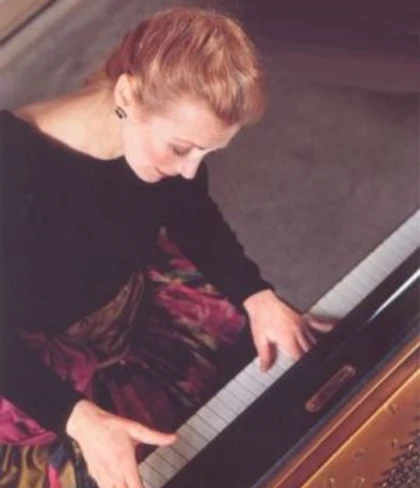
After explaining that technical difficulties were interfering with the video transmission, President Rebecca Eng called upon Programs Chair Sophia Agranovich to introduce Dr. Barbara Nissman, pianist, recording artist, lecturer, master class teacher, author, and friend of Ginastera (pronounced Geenastera). We would be treated to her stunning piano performances and most interesting comments. She has performed with some of the world’s leading conductors and orchestras and is regarded as an outstanding interpreter of the piano works of Alberto Ginastera and Sergei Prokofiev.
For more information, see https://www.barbaranissman.com/page2 and https://en.wikipedia.org/wiki/Barbara_Nissman
Maggie Haskind, an editor from Boosey & Hawkes was present, and it was announced that the publisher would soon be coming out with the complete piano works of Ginastera.
Barbara first met Ginastera when he was a guest composer at her school, the University of Michigan. A lifelong friendship developed. Ginastera’s early promise to write a piano concerto for Barbara was not kept, but at the end of his life, he dedicated his third sonata to her, composing in his hospital bed. The delay was partly due to the many commissions Ginastera was committed to fulfill.
To Barbara, his music “is ‘gut’ music, passing the brain and going to the heart.” She learned his first piano sonata (written in 1952). The elements appearing there were developed and transformed in his first piano concerto (1962). The composer was an excellent orchestrator and colorist. This colorist ability is evident in his piano music, where great freedom is shown in rhythms, harmonies, tone clusters, references to guitar tunings and strumming, and textures. Barbara spoke of the joy that much of the music expresses, and the use of rubato while maintaining pulse.
Ginastera maintained that form was the most important feature of a composition. “A work without form is a work deformed,” he declared. In his music, short motives are often repeated, and that is where dynamics give shape to the repetitions. Understanding the form of a composition is essential for meaningful interpretation. Considering the nature of Ginastera’s compositions, his pounding chordal passages are reminiscent of Béla Bartók’s Allegro Barbaro. Other influences are indigenous people’s music, Argentinian folk music, and the music of the pampas: the melodies, pulsating rhythms, the “very Latin American” characteristics.
Barbara played some of the Danzas Argentinas. In the first dance, you heard the pitches of guitar open strings and repeated patterns related to guitar strumming. In the second, Danza de la moza donosa, the inner voice could be followed supporting the treble. In the spectacular Danza del gaucho matrero, a lot of joyful motion in the busy A section contrasts with slower chords in the middle section of a rounded binary form.
The influence of guitar is always present. Barbara added that Astor Piazzolla studied with Ginastera. Ginastera eventually was fired because of political views. He went to the U.S. and got a scholarship at Tanglewood. He later composed for the film industry.
Barbara Nissman discussed his 12 American Preludes. She then performed the Piano Sonata No. 1 (1952). Each movement had a distinct character. She commented that a steady pulse was important but “you don’t want to sound academic.” The last movement, Milonga, has a shifting rhythmic pattern: 2.2.2./3.3. ”It is Ginastera’s answer to Prokofiev’s seventh sonata.” Barbara Nissman is also an authority of Prokofiev’s music, an understandable relationship to Ginastera’s. She said Ginastera’s second piano sonata was more complicated than his first, using thick chords, tone clusters, and novel rhythms. In the second movement, the separation of the interval of a second by several octaves made the dissonance tolerable to listeners. We were then treated to a spectacular performance of his third piano sonata of one movement, which was dedicated to Barbara Nissman. A short Q. and A. closed this very exciting meeting.
Bertha Mandel, writer
Like to share music, music-related ideas, classes, concerts? Dialogue with other musicians or teachers? Click on the links below to visit our social media pages and find out more.


The Music Educators Association of NJ is a non-profit 501(c)(3) organization of private piano teachers founded in 1927. Our mission is to raise the standards of private music teaching throughout New Jersey, while encouraging musical excellence and instilling a love of music in our students.


